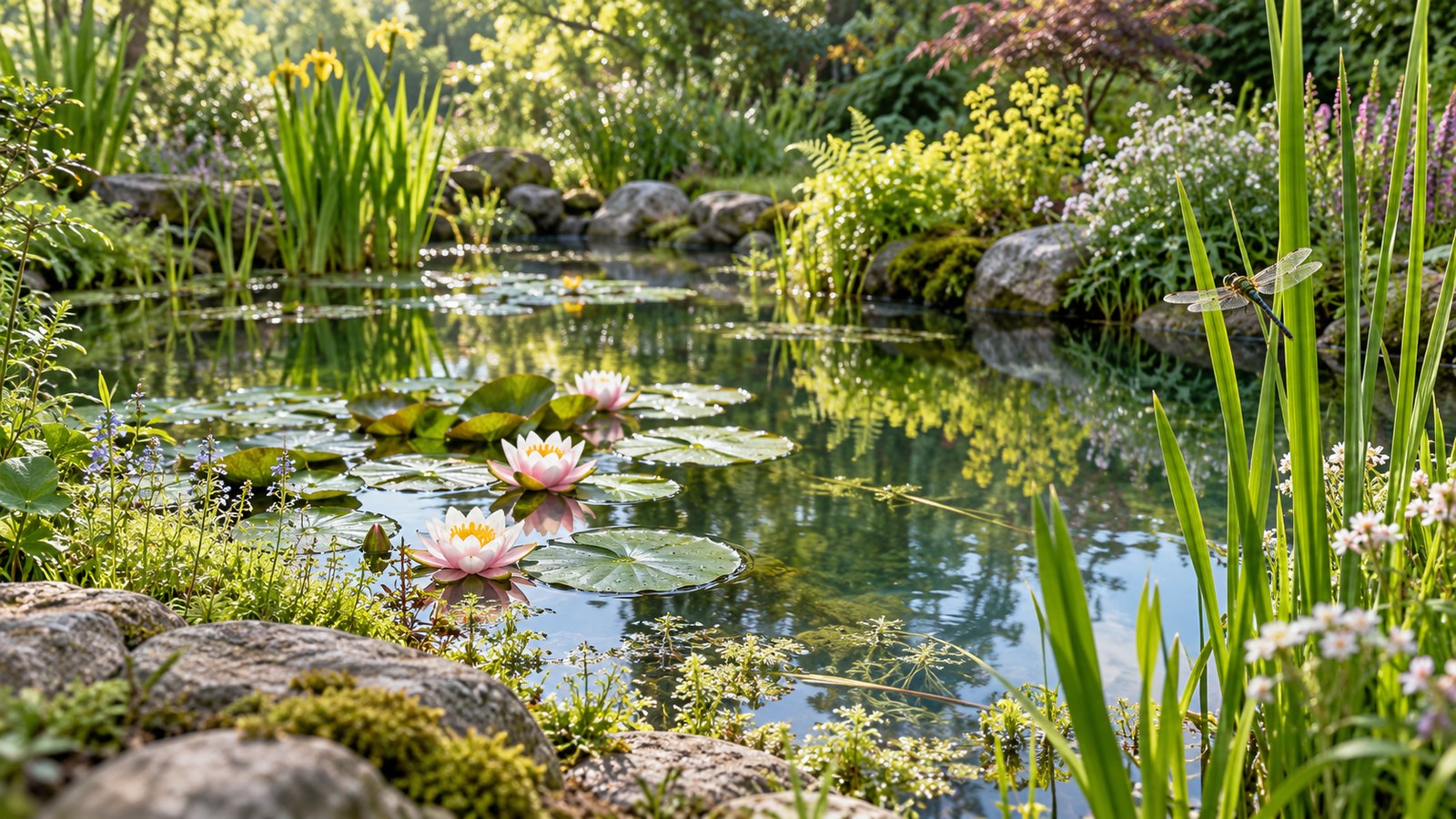
A pond does not always need a manufactured filter. A planted wildlife pond with no fish can function without one. A koi pond, or a fish pond with substantial feeding and stocking, generally needs a deliberately designed filtration system. Between those cases are lightly stocked water gardens where the answer depends on the pond's balance and how closely it is monitored.
The useful question is not simply whether the water looks clear. Ask what enters the pond, how fish waste is processed, how oxygen is maintained, and how debris is removed. A filter is one way to address those jobs; it does not remove the need to manage the pond.
This guide concerns domestic garden ponds. Farm ponds, reservoirs, natural lakes, and swimming ponds require different assessments. Featured artwork is an AI-generated illustrative pond scene.
On this page
- Start with the kind of pond you want
- A wildlife pond can work without a manufactured filter
- Goldfish ponds need a closer look
- Koi ponds should be designed around waste and oxygen
- Understand the different jobs equipment performs
- Clear water is not proof that a fish pond is safe
- How to decide whether your pond needs added filtration
- Adding a filter without creating avoidable problems
- Can plants or a bog replace a filter?
- Frequently asked questions
- Make the decision from the pond’s needs
Start with the kind of pond you want
| Pond type | Starting position | What should determine the next step? |
|---|---|---|
| Wildlife pond with no fish | A manufactured filter may be unnecessary | Planting, runoff control, debris management, and wildlife goals |
| Planted water garden with a modest fish population | Assess before deciding | Fish size, feeding, measured water quality, circulation, and maintenance |
| Regularly fed goldfish pond | Plan suitable filtration rather than relying on appearance | Waste load, stocking changes, and equipment capacity |
| Koi pond | Design filtration as part of the pond system | Adult fish load, solids removal, biological treatment, and oxygen |
| Existing fish pond with repeated water-quality trouble | Diagnose the cause | Test results, flow, maintenance history, and stocking |
The Royal Horticultural Society's pond-filter advice distinguishes ponds with many fish from ponds with few or none. Oklahoma State University's water-garden guidance also explains that a balanced planted garden with modest fish numbers may not need additional filtration. Neither principle means every unfiltered fish pond will remain safe.
A wildlife pond can work without a manufactured filter
A wildlife pond is usually designed around habitat: shallow areas, aquatic plants, cover, and access for animals. It is not primarily a container for regularly fed ornamental fish. That distinction changes what equipment is useful.
For a new wildlife pond, consider the site before considering a pump. Will rainwater carry fertilizer or sediment into it? Is most of the surface likely to be buried under autumn leaves? Can suitable plants establish without overwhelming the open water? These questions help identify the sources of future maintenance problems.
The aesthetic goal matters too. Natural water is not expected to look like a tiled swimming pool. A little seasonal change, visible aquatic life, and vegetation around the margins can be consistent with a healthy wildlife habitat. Buying a filter solely to remove every trace of a natural appearance may not serve the pond's purpose.
That does not mean neglecting the pond. Check water level, remove problem debris when appropriate, and watch for persistent changes. If conditions deteriorate, investigate the cause. Installing equipment without understanding that cause can spend money while leaving the main problem in place.
Goldfish ponds need a closer look
A lightly stocked, planted goldfish pond is different from a pond holding many fish that are fed every day. The species name alone cannot determine whether filtration is adequate. Five small fish and five large fish do not represent the same load.
Consider how the pond has changed since it was installed. Have fish grown? Has feeding increased? Have plants or seasonal debris reduced the amount of open water? Is a previously useful circulation route now obstructed? A pond can outgrow its original management plan without the owner adding another fish.
If you choose an unfiltered arrangement, that choice should be supported by the pond's actual condition and conservative management. It should not rest on “the fish have survived so far.” Survival, clear water, and adequate waste processing are different observations.
For a pond with routine feeding, a suitable manufactured system can make waste handling more predictable. The appropriate system might combine mechanical capture, biological treatment, and circulation. Selection should start with the volume and expected fish load. Our pond filter sizing guide explains how to gather those details.
Koi ponds should be designed around waste and oxygen
Koi keeping usually involves a stronger commitment to fish load, feeding, and long-term maintenance than a wildlife pond. For that reason, filtration should be part of the initial design rather than a later accessory chosen after water turns green.
Start by defining the fish you intend to keep as they grow. Then assess how solids will be collected, where biological treatment will occur, and how the system will maintain appropriate circulation and oxygen. A decorative fountain and a small intake sponge should not be assumed to cover those requirements.
Also consider what happens during an interruption. Can essential aeration be maintained? Is the owner able to detect a stopped pump? Does the layout create an avoidable risk of draining the pond through a disconnected return? These are system questions that cannot be answered by a filter's gallon rating alone.
If an existing koi pond repeatedly needs emergency attention, a larger canister may not be the complete solution. The problem could involve a limited solids-removal arrangement, poor flow distribution, excessive feeding, or insufficient biological capacity. Diagnose the installation before making a replacement purchase.
Understand the different jobs equipment performs
Mechanical filtration captures particles
Mechanical media intercept suspended debris. The captured material remains in the system until it is removed. A filter pad that is full of trapped waste needs appropriate servicing; the act of catching waste does not make that waste disappear.
When inspecting a mechanical stage, ask where material accumulates and how you will clean it. Is there a basket, pad, settlement area, or drain? Can it be reached without a difficult lift? A system that is theoretically effective but rarely serviced can be a poor practical choice.
Biological filtration processes dissolved waste
Biological media provide surfaces on which microbial communities develop. In the familiar nitrogen cycle, ammonia is converted to nitrite and then nitrate. Both ammonia and nitrite can be harmful to fish; biological treatment is not simply a method for making water look clearer.
The Aquascape explanation of the pond nitrogen cycle describes these conversions. A newly installed system should not be assumed to have full biological capacity immediately. Follow appropriate startup guidance and use test results to judge progress rather than relying on a promised number of days.
UV clarification addresses suspended green-water algae
A suitable UV clarifier can help with suspended algae responsible for green water. It does not supply all the jobs of a biological filter, remove settled debris from the pond floor, or establish that fish-pond chemistry is safe.
This is why “buy a UV” is not a universal answer to a pond problem. First identify what is making the water look wrong. A muddy pond after heavy rain, accumulated leaves, and suspended green algae are different problems. Treating them as one issue encourages unnecessary purchases.
A pump moves water; an aerator serves a different role
A pump can circulate water through equipment or supply a feature. An aerator increases gas exchange through its intended arrangement. Neither label, by itself, proves that the whole pond is receiving suitable treatment and circulation.
When evaluating equipment, describe its function precisely. “There is a pump” is less useful than “this pump supplies this filter through this hose and returns water here.” Specific descriptions make it easier to identify a missing stage or an unsuitable route.
Clear water is not proof that a fish pond is safe
Visibility is an observation, not a complete water-quality test. A pond may look attractive while the fish are exposed to a problem that cannot be seen. Equally, some coloration in a wildlife pond does not automatically mean that a manufactured filter is needed.
For a fish pond, keep records of appropriate water tests, maintenance, feeding, and important changes. Record values with dates rather than remembering that a reading was “fine.” A trend is more informative than a single isolated result.
Avoid changing several things at once unless there is an urgent welfare issue. If you simultaneously replace media, change feeding, add treatments, and alter the pump, it becomes difficult to know which change helped or caused another problem. A measured approach improves both diagnosis and future decisions.
Fish gasping, loss of balance, or sudden deaths need prompt investigation. Check circulation, aeration, and water quality, and obtain competent local help. Do not postpone action while waiting for a new filter to arrive or assume that a clearer pond will resolve the cause.
How to decide whether your pond needs added filtration
1. Write down the pond's purpose
Choose the actual purpose: wildlife habitat, planted water garden, ornamental fish pond, or koi collection. Trying to satisfy all purposes with one vague description makes equipment choices harder. The purpose should guide what “good water” and suitable management mean for your project.
2. Record what enters the water
List fish feed, fallen leaves, runoff, decomposing plant material, and any other important inputs. Rank them by what you observe rather than by what a product advertisement mentions. A filter upgrade will not prevent contaminated runoff from entering the pond.
3. Measure the pond and review the fish load
Estimate volume using actual internal dimensions and average depth, or use a measured fill record. Note both current fish and realistic future growth. These details are needed if filtration is selected later, so gathering them is useful even before deciding to buy.
4. Inspect the existing flow route
Check that the pump is working, the intake is not blocked, and return water is reaching its intended location. An equipment failure or dirty stage can resemble insufficient capacity. Restore normal operation before drawing conclusions about whether the original system is undersized.
5. Use observations and tests to decide
For fish ponds, combine relevant test results with maintenance history and stocking. For wildlife ponds, assess habitat goals and the sources of persistent trouble. If evidence indicates that the current arrangement is not handling the load, choose a system that addresses the specific shortfall.
Adding a filter without creating avoidable problems
A new filter is most useful when the installation and transition are planned together. Decide where it will sit, how water will reach it, and how it will return. Provide a safe, accessible maintenance area rather than choosing a location solely for concealment.
For an established fish pond, follow a considered transition plan. Removing all mature biological media at the same time as installing a new system can reduce existing biological treatment. Obtain model-specific guidance for moving or retaining suitable media, and monitor water quality during the change.
Use the equipment's own electrical and installation instructions. Keep mains-powered equipment and connections in the arrangements specified by the manufacturer, and have permanent outdoor electrical work carried out appropriately. A garden pond is not a place to improvise electrical connections.
Once the system is running, inspect the pond level, hoses, connections, filter, and return. Decide what warning signs you will check routinely. A small problem found early is easier to address than an unnoticed leak or stopped return.
If you need help choosing the equipment format, compare the different architectures in our best pond filters guide. A pressure filter, gravity-return box, and submerged integrated unit solve different layout problems.
Can plants or a bog replace a filter?
Plants contribute to a pond's ecosystem, but “add more plants” is not a documented capacity calculation. Planting is one component of a balanced wildlife or water-garden design. It should not be treated as an automatic substitute for filtration in a regularly fed, heavily stocked fish pond.
A purpose-built bog is itself a filtration arrangement. It has a flow path, media, planting, and maintenance needs. Calling it natural does not remove the need to consider waste accumulation or access. A planted corner without an intentional water route is not necessarily performing the same job.
Before relying on a bog as a major treatment stage, determine how solids will be managed and how the bed can be serviced. If the design cannot be maintained when it clogs, its attractive appearance does not solve that weakness.
Frequently asked questions
Does a pond without fish need a filter?
Often it does not, especially when it is designed as a balanced wildlife pond. Investigate persistent trouble rather than assuming all ponds need powered filtration. Runoff control and debris management may be more relevant than equipment.
Does a small pond need less filtration?
Small volume does not establish low waste load. A small pond with regular feeding can need more active management than a larger pond with few inputs. Size equipment for the whole situation, not only the pond dimensions.
Can I replace filtration with frequent water changes?
Water changes and filtration perform different functions. Appropriate partial changes can be part of fish-pond management, but they are not a reason to overlook biological treatment or solids removal. Replacement water must also be suitable for the fish.
Should I turn the filter off every night?
Do not treat a biological fish-pond system as a decorative feature with an arbitrary timer. Follow the manufacturer's operating guidance and account for the needs of the biological stage and fish. Consider running costs while designing the system, rather than reducing operation without assessing the consequences.
Make the decision from the pond's needs
A fish-free wildlife pond may be better served by good planting and management than by a filter purchase. A regularly fed fish pond deserves an assessment of waste processing, circulation, and maintenance. A koi pond should have those functions deliberately designed from the outset.
If you decide to add filtration, the next step is to measure the pond and check filter sizing. That produces a purchase decision based on the actual project, instead of buying the largest-looking filter and hoping it solves an unidentified problem.